Greyhound Results Towcester — Home of the Derby
Best Greyhound Betting Sites – Bet on Greyhounds in 2026
Loading...
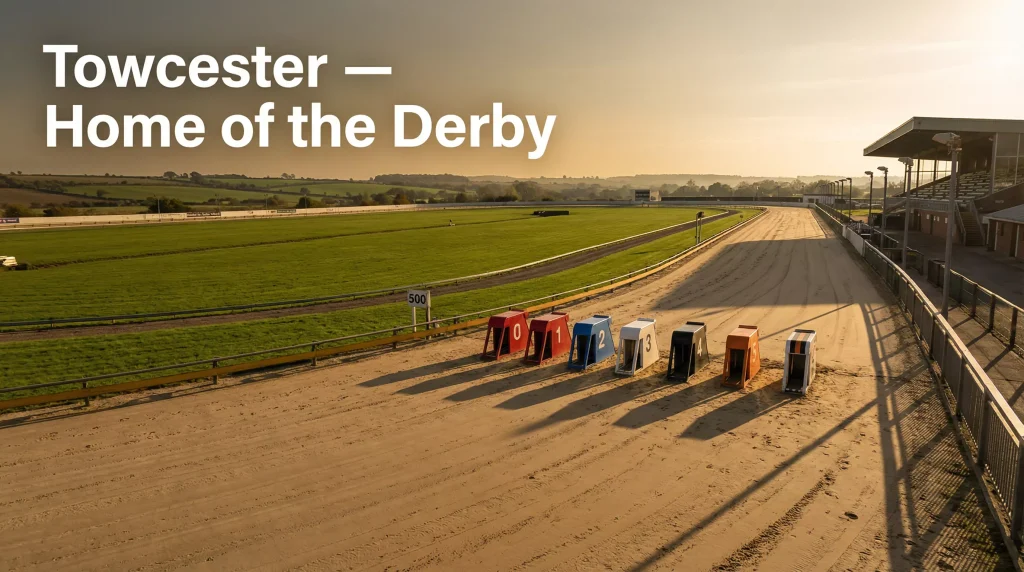
Towcester is where the Derby is decided. That single fact places it in a category apart from every other greyhound venue in Britain. While several tracks race more frequently and generate more daily results, none carries the same competitive prestige as the Northamptonshire circuit that hosts the English Greyhound Derby — the sport’s flagship event, with a winner’s prize of £175,000 and a six-round knockout format that attracts around 180 entries from the country’s top kennels.
Beyond the Derby, Towcester is a fully operational GBGB-licensed track that stages regular meetings throughout the year. Its results data feeds into the national form book alongside every other licensed venue, and for punters who analyse greyhound form seriously, understanding the track’s specific characteristics — its wide, galloping layout, the distances it offers and its place in the BAGS and open-race fixture calendar — is essential context for reading those results accurately.
Towcester Track Profile and Derby Connection
Towcester is a large, galloping track that stands in sharp contrast to the tighter London and Midlands circuits. The bends are wide and sweeping, the straights are long and the overall circumference is generous by UK standards. This geometry produces a distinctive type of race: one where stamina and sustained mid-race pace matter more than at compact tracks, and where a dog that breaks slowly but possesses a strong finish has a realistic chance of running down early leaders through the closing stages.
The standard race distances at Towcester are 270, 480 and 500 metres, with the 500m trip serving as the marquee distance — not least because it is the Derby distance. The 480m trip is used for regular graded racing and BAGS fixtures, while the 500m distance is more closely associated with feature events, open races and the Derby rounds themselves. The difference between 480m and 500m may appear negligible on paper, but on a large track like Towcester it introduces an extra section of running that can change the tactical dynamic of a race. Dogs that are marginal at 480m sometimes find the extra 20 metres either works in their favour — if they have stamina to burn — or exposes them, if they are already at the limit of their distance range.
The Derby connection gives Towcester’s results an additional layer of significance during the summer months. Each round of the competition produces heat-by-heat data — sectional times, finishing positions, SPs and comments — that is scrutinised more intensely than any other greyhound results in the calendar. The six-round format generates a cumulative form profile for each surviving dog, and because every round takes place at the same track over the same distance, the data is directly comparable in a way that multi-venue competitions cannot replicate. The BAGS programme also runs at Towcester, keeping the track active year-round with over 25,000 BAGS races staged across all licensed venues annually. Towcester’s contribution to that total ensures a steady baseline of non-Derby form data.
From an analytical standpoint, Towcester rewards dogs with a particular running style. The wide bends mean that outside draws are less penalised here than at tighter tracks — a dog drawn in trap 5 or 6 at Towcester is under less disadvantage than the same draw at Romford or Crayford, because there is more room to hold position without losing ground. This makes trap draw a less dominant variable in Towcester results than at some other venues, and punters should weight it accordingly when using the data for selections.
Accessing Towcester Results
Towcester results are distributed through the standard GBGB data infrastructure. Finishing positions, starting prices, sectional times and race comments are available on all major bookmaker platforms and independent form sites after each race. During the Derby period, this data receives additional editorial coverage from tipsters and racing media, but the raw data format is identical to results from any other meeting throughout the year.
For punters following Towcester specifically, most form databases allow filtering by track and date, isolating a full meeting card for sequential review. This is particularly valuable during the Derby weeks, when the volume of races and the intensity of analysis required can be overwhelming if results are pulled piecemeal rather than viewed in meeting order. Reviewing each round’s full set of heats in sequence — noting which dogs progressed, which were eliminated and how the sectional times compared across heats — builds a compound picture that individual results cannot provide alone.
Outside the Derby window, Towcester’s regular meetings produce form data that should be read with the track’s galloping nature in mind. Times at Towcester are not directly comparable with times at shorter-circumference tracks without adjusting for the difference in geometry. A 480m time at Towcester that looks modest by Romford standards may represent a strong run in context, because the wide bends and longer straights mean that dogs are covering more ground at each stage of the race.
Towcester Fixture Calendar and Feature Events
Towcester’s fixture calendar includes regular BAGS afternoon meetings and evening open cards, with the summer months dominated by the Derby programme. Outside of the Derby, the track hosts feature events and category races that attract quality entries, giving the regular fixture list competitive peaks that add depth to the available form data.
The BAGS component of the schedule keeps the track active during the quieter months, ensuring a year-round supply of results data. For form analysts, this continuity matters: it means that a dog racing at Towcester in January has track-specific form that can be compared with its runs in March, April or May, building a longitudinal picture that single-season snapshots cannot match.
The Derby itself is the dominant fixture in Towcester’s calendar and, arguably, in the entire UK greyhound racing calendar. The six-round format stretches across several weeks, generating a sustained period of high-quality racing and intensive form analysis. For punters, the Derby results are the richest single dataset in the sport — a controlled experiment where the same dogs race at the same track over the same distance in progressively tougher company. That is rare in greyhound racing, and it makes Towcester’s summer output uniquely valuable.
The weekly fixture list is published by GBGB and replicated on all major form platforms. During the Derby period, the schedule receives wider attention than at any other time, but the regular non-Derby meetings are equally worth tracking for anyone who follows Towcester form throughout the year. The track’s distinctive galloping character means that form generated here does not always translate smoothly to tighter circuits — and vice versa — so maintaining a Towcester-specific view alongside broader analysis is the most reliable approach.