
What Does SP Mean in Greyhound Racing — Starting Price Explained
Best Greyhound Betting Sites – Bet on Greyhounds in 2026
Loading...
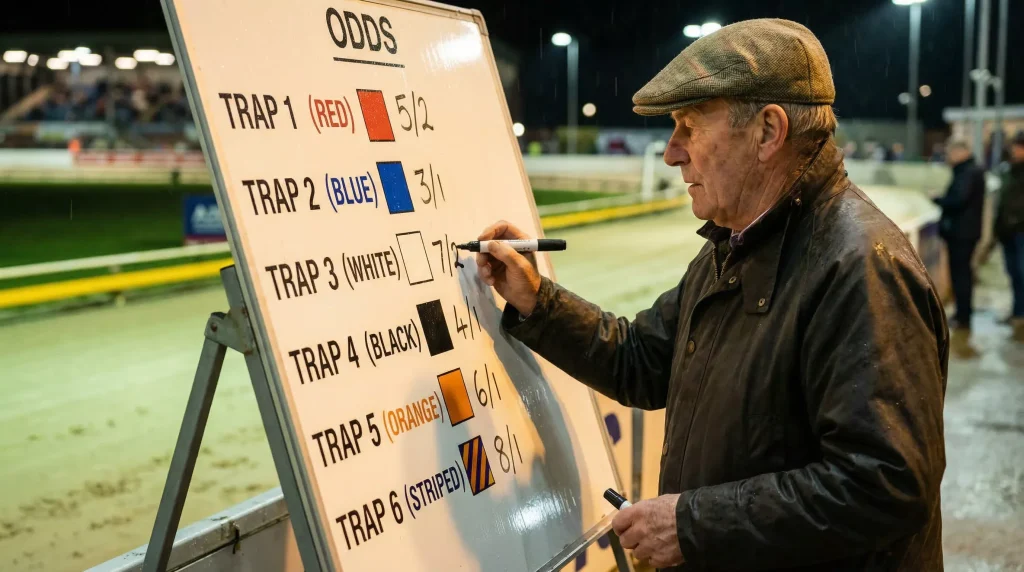
SP stands for starting price — the final set of odds attached to a greyhound at the moment the traps open. It is the price that counts. If you place a bet at SP rather than taking a fixed early price, your payout is determined by whatever the market settles at just before the race begins. It is, in effect, the market’s final word on each dog’s chance of winning.
For anyone reading greyhound results, SP appears alongside every runner in every race. It is one of the most frequently displayed data points in the form book, yet its meaning and mechanics are often misunderstood — particularly among newer punters who may not realise how SP is set, what drives it to move, or how it differs from the exchange-based BSP used on platforms like Betfair. This guide explains each of those elements in practical terms, without jargon.
How SP Is Determined at UK Tracks
The starting price of a greyhound is determined by on-course bookmakers at the track where the race is being held. In the minutes before each race, bookmakers display their odds on boards at the venue, adjusting them in response to the money being wagered. As punters back certain dogs, the odds on those dogs shorten; dogs that attract less interest see their odds drift longer. The SP is the final price showing on the board when the traps open — a snapshot of where the betting market stands at the last possible moment.
This mechanism means that SP is a product of supply and demand. It reflects not just a bookmaker’s assessment of each dog’s chance, but also the pattern of money flowing into the market. A dog that attracts heavy support from on-course bettors will have a shorter SP than its raw form might suggest, while one that is overlooked despite decent form may go off at a longer price. The SP is therefore both an odds line and a popularity indicator, and reading it as both of those things simultaneously is key to using it analytically.
The scale of the market behind greyhound SP is substantial. Off-course betting turnover on greyhounds in the UK reached approximately £794 million in the year to March 2024, and the on-course market at each track adds a further layer of price-setting activity. That liquidity means SP in greyhound racing is generally robust — there is enough money flowing through the system to produce prices that reflect genuine market opinion rather than the idiosyncrasies of a thin, illiquid book.
One nuance worth understanding is the difference between SP at a major evening open meeting and SP at a standard BAGS afternoon card. At a well-attended evening fixture, the on-course market is deeper, with more bookmakers competing and more punters placing bets. This tends to produce tighter, more efficient prices. At a quieter afternoon meeting, the on-course market may be thinner, which can lead to wider spreads and SP figures that are slightly less reflective of true probability. Recognising which type of meeting a result comes from helps frame the SP in appropriate context.
SP vs BSP: Key Differences
BSP stands for Betfair Starting Price — the final odds generated by Betfair’s exchange at the point of race-off. While SP is set by traditional bookmakers on course, BSP is determined by the matching of back and lay bets on an exchange platform. The two prices often align closely, but they can diverge meaningfully, and understanding when and why they differ is useful for both betting and form analysis.
The key structural difference is this: SP is set by bookmakers who manage their own risk and margin, while BSP is a peer-to-peer price driven by exchange users backing and laying against each other. Bookmakers build an overround into their odds — meaning the implied probabilities of all runners in a race add up to more than 100% — which gives them a margin. The exchange does not operate in the same way; BSP is closer to a pure market-clearing price, minus a small commission charged by the platform.
In practice, BSP tends to offer marginally better value on favourites and a less consistent advantage on outsiders. This is because exchange users are often more price-sensitive on short-priced runners, pushing the BSP closer to true probability, while the bookmaker SP on outsiders can already be generous enough to match or exceed the exchange price. For greyhound form analysis, the comparison between SP and BSP on a given dog can reveal where market opinion was concentrated — a dog whose BSP was significantly shorter than its SP attracted heavy exchange support, possibly from informed punters who identified it late.
Greyhound racing represents 12.8% of average licensed betting office turnover, which makes it a significant contributor to the high-street bookmaker market. That share of turnover means the SP on greyhound races is not a marginal or illiquid figure — it is backed by real, commercially meaningful volume. The BSP on the same races reflects a different pool of money, but the combined picture of both prices gives the most complete view of how the market assessed each runner.
Finding SP in Results Data
SP is displayed as a standard field in virtually every greyhound results format. Whether you are using a bookmaker results page, an independent form database or a GBGB data feed, the SP column appears alongside finishing position, trap number, time and distance. It is typically expressed in fractional odds — 5/2, 7/4, 11/8 and so on — though some platforms also display the decimal equivalent.
When reading a results card, the SP tells you two things at once. First, it tells you the market’s assessment of each dog’s chance before the race. Second, it allows you to calculate what the return would have been for an SP bet on each runner. A winner at 5/2 SP returned £3.50 for every £1 staked; a winner at 1/2 returned £1.50. Comparing these returns across a dog’s recent form gives you a sense of whether the market is consistently underestimating or overestimating it — a pattern that, if it persists, may represent genuine value.
For form analysis, tracking SP trends across a sequence of results is one of the most efficient ways to identify a dog whose ability is being reassessed by the market. A dog whose SP has shortened from 5/1 to 7/2 to 5/2 across three runs is attracting increasing support — the market is telling you that informed money sees something improving. Conversely, drifting SP across consecutive races suggests a dog that is losing support, which may reflect declining form or a kennel issue that is not yet visible in the finishing positions alone. SP is not just the price that counts on race day — it is a form indicator in its own right.