100 Years of Greyhound Racing — 2026 Centenary
 Available in US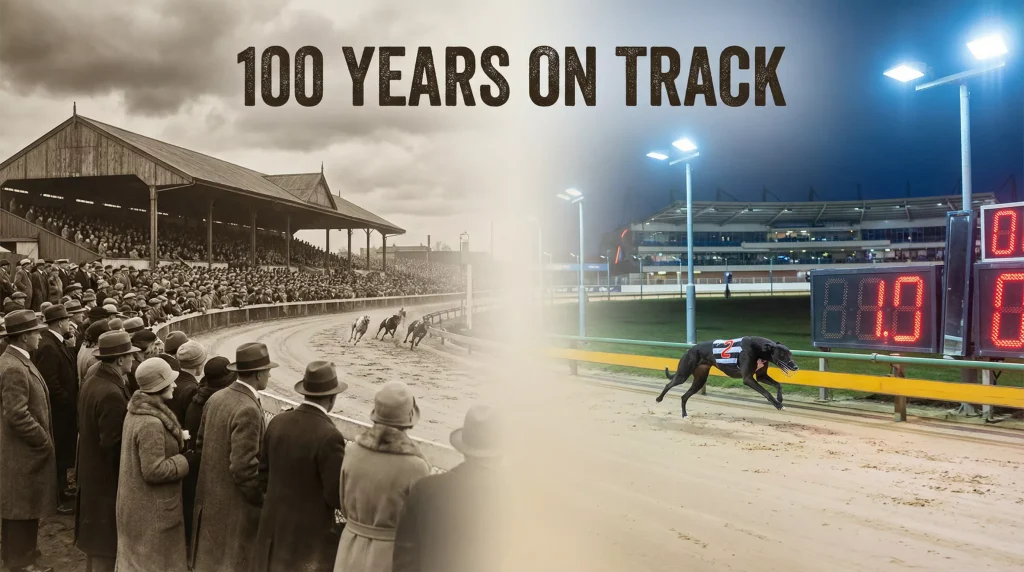
On 24 July 1926, a crowd of 1,700 gathered at Belle Vue Stadium in Manchester to watch a greyhound called Mistley chase an electric hare around a 440-yard oval track. It was the first organised greyhound race in Britain, and it launched an industry that would become one of the country’s most popular spectator sports within a decade. In 2026, UK greyhound racing marks a century at the track — a milestone that invites both celebration and reflection on a sport that has transformed repeatedly across ten decades. The wider context is set out in our UK greyhound results guide.
The centenary is not merely a date on the calendar. It is a point from which to survey a sport that has gone from mass entertainment to niche pursuit, from unregulated spectacle to data-driven betting medium, and from cultural fixture to contested activity facing legislative bans in parts of the UK. Understanding the arc of those hundred years gives essential context for anyone following the sport today.
The First Race: Belle Vue, July 1926
The Belle Vue meeting was the product of American innovation transplanted to British soil. Greyhound racing with an electric lure had been developed in the United States in the early 1920s, and a group of entrepreneurs — recognising the potential for a new form of popular entertainment — brought the concept across the Atlantic. Manchester was chosen for the launch partly because of its large working-class population and partly because Belle Vue was already an established entertainment venue with the infrastructure to stage a sporting event.
The first card consisted of six races, with seven dogs in each, and the response was immediate. Within weeks, other cities were scrambling to build or convert stadiums for greyhound racing, and by the end of 1927, tracks had opened in London, Birmingham, Edinburgh and several other major centres. The sport’s growth in its first five years was extraordinary by any standard — a new entertainment product that required minimal explanation, offered an evening out with the possibility of a bet, and fitted neatly into the social rhythms of industrial-era Britain.
What made greyhound racing uniquely accessible was its simplicity. Unlike horse racing, which required large rural estates and day-long excursions, greyhound racing took place in urban stadiums within walking distance of housing and public transport. A meeting lasted a couple of hours, the races were short and frequent, and the betting was straightforward. It was, in the language of a later era, a perfect product-market fit — a sport designed for city dwellers who wanted entertainment, a flutter and a night out without the expense or travel that horse racing demanded.
The speed of adoption created its own regulatory challenges. With dozens of tracks opening in rapid succession and no established governing body, standards varied wildly. Some tracks were well run; others were chaotic. The pressure for regulation grew quickly, and by the early 1930s, the sport’s first governing structures were taking shape — precursors to the GBGB that regulates the sport today.
Key Decades in UK Greyhound Racing
The 1930s and 1940s were the golden era. Attendance figures reached extraordinary levels — peak annual attendance across all UK tracks is estimated to have exceeded 50 million in the late 1940s, making greyhound racing one of the most attended sports in Britain. The sport operated alongside horse racing as one of the two pillars of the betting industry, and the stadiums became social hubs for their local communities. The war years disrupted but did not halt racing; many tracks continued to operate, providing entertainment and a semblance of normality during the Blitz.
The decline began in the 1960s, driven by the twin forces of television and the legalisation of off-course betting. Television gave people entertainment at home; the Betting and Gaming Act 1961 allowed high-street betting shops to open, which meant punters could bet on greyhound racing without attending the track. Both developments eroded the live-attendance model on which tracks depended. Through the 1970s and 1980s, stadiums began closing — slowly at first, then with increasing frequency as property values rose and the commercial case for maintaining a racing operation weakened.
The late 1990s and 2000s saw a further contraction, with iconic London venues — Wimbledon, Walthamstow, Catford — closing for redevelopment. Each closure removed a track from the racing circuit and reduced the sport’s footprint in the capital. By the 2010s, the number of licensed tracks had stabilised at around twenty, and the sport’s economic model had shifted decisively from live attendance to media rights and betting-shop content, driven by the BAGS fixture programme.
The 2020s have introduced a new dimension: legislative pressure. The Welsh and Scottish bans, both moving through their respective parliaments, represent the first government-level moves to prohibit greyhound racing in parts of the UK. Whether this pressure extends to England — where all 18 licensed tracks currently operate — remains to be seen, but the centenary arrives at a moment when the sport’s future is more uncertain than at any point since its founding.
The Centenary Celebrations in 2026
GBGB and the wider industry have marked the centenary with a programme of events designed to celebrate the sport’s heritage while acknowledging its evolution. The most notable event was the first combined horse and greyhound race day in UK history, held at Dunstall Park in Wolverhampton on 7 March 2026 — a fixture that symbolically linked Britain’s two racing traditions in a single day’s sport.
Sir Philip Davies, the GBGB Chairman, used his centenary address to note the milestone of one hundred years since racing first took place at Belle Vue in 1926. The celebrations have also included heritage exhibitions at several tracks, commemorative race cards and a series of feature events across the licensed circuit. Mark Bird, the outgoing GBGB Chief Executive, has emphasised the centenary as an opportunity to highlight welfare progress, noting that licensed greyhounds now benefit from more protection than domestic pets — a claim backed by the regulatory framework, data transparency and veterinary provision that GBGB has built over the past decade.
The centenary is also, inevitably, a moment for the sport’s critics. Welfare organisations have used the anniversary to argue that a hundred years of greyhound racing is a hundred years too many, pointing to cumulative injury and fatality data as evidence that the activity causes inherent harm regardless of regulatory improvements. The timing of the Welsh and Scottish bans — both advancing through their legislatures in the centenary year — adds a pointed counterpoint to the celebrations. How many tracks survive today is in UK tracks.
For punters and form analysts, the centenary is less about sentiment and more about perspective. The sport that produces today’s results is unrecognisable from the one that started at Belle Vue in 1926 — the data infrastructure, the regulatory standards, the welfare provisions and the betting markets have all been transformed. A century at the track has produced a sport that, whatever its future holds, generates the most comprehensive and transparent results data in its history. That data is the centenary’s most useful legacy for anyone who follows greyhound racing seriously.
