Greyhound Race Distances by Track — UK Circuit Guide
Best Greyhound Betting Sites – Bet on Greyhounds in 2026
Loading...
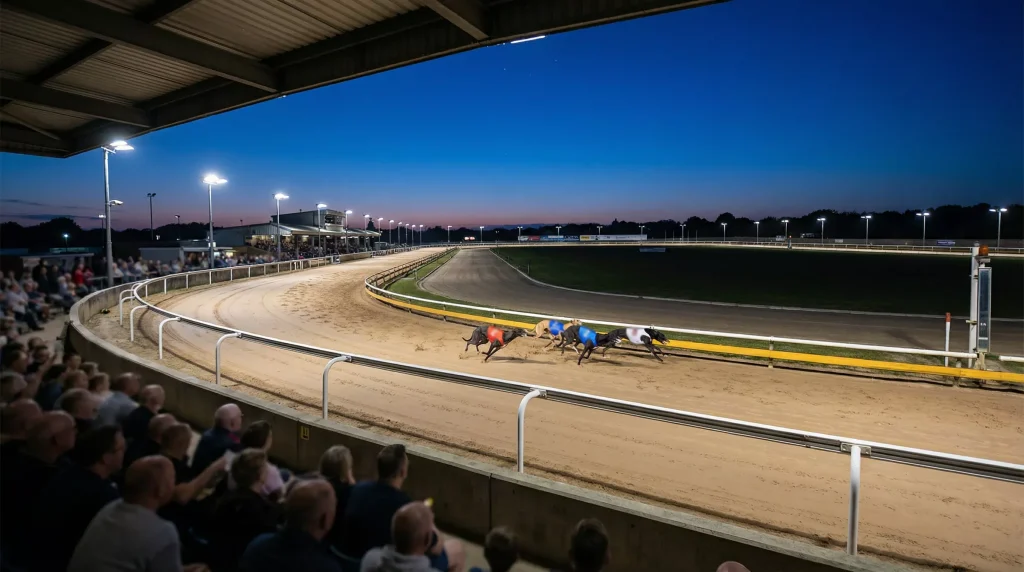
Distance matters. It is one of the first variables any serious form analyst checks when reading a greyhound result, because the same dog can look like a different animal over different trips. A sprinter that dominates at 270 metres may be exposed at 480, and a stayer that grinds out wins at 660 might lack the early pace to compete over a shorter distance. Across the 18 GBGB-licensed stadiums in England and Wales, the range of race distances is broader than many casual followers realise — and understanding which tracks offer which trips is fundamental to interpreting results accurately.
This guide maps the standard and non-standard distances used at UK greyhound tracks, explains how distance categories differ in their tactical demands, and examines the relationship between distance and race outcomes. Whether you are reading today’s results or studying archived form, the distance column is a data point that should never be treated as background noise.
Standard Distances Across UK Tracks
Every GBGB-licensed track operates over a set of standard distances that are determined by the circuit’s geometry — specifically, the length of the straights and the circumference of the track. These distances vary from venue to venue because no two tracks are built to identical dimensions. What one track calls its standard middle-distance trip might be 400 metres, while another offers 480 or 500. The variation is not arbitrary; it is a physical consequence of each track’s layout.
The most common standard distances across the UK circuit fall into three broad categories: sprints (typically 225–280 metres), standard middle distances (380–500 metres) and marathon or endurance trips (600–714 metres). The middle-distance category is where the vast majority of graded racing takes place. It is the trip that appears most often on BAGS afternoon cards and evening open meetings, the trip most frequently used for grading assessments, and the trip that generates the deepest pool of form data for each track.
To give a sense of the spread: Romford’s core distance is 400 metres, Crayford operates at 380, Monmore and Sheffield at 480, Hove at 500 and Towcester — home of the English Greyhound Derby — at 500 metres for its marquee events. These differences may seem marginal on paper, but in practice they produce measurably different race dynamics. A 380m race at Crayford plays faster and more front-runner-friendly than a 500m race at Towcester, where the longer trip and wider bends allow dogs to close from behind.
For punters cross-referencing form between tracks, the distance difference is the first adjustment to make. A dog that dominates at 400m cannot be assumed to handle 500m without evidence, and vice versa. Checking whether a dog has previously raced at the distance in question — and how it performed — is a basic but frequently overlooked discipline in form analysis. The results data includes the race distance for every run, making this check straightforward for anyone willing to look.
Non-Standard Trips: Hurdles, Marathons, Sprints
Beyond the standard race distances, UK greyhound racing includes a range of non-standard trips that serve different competitive and analytical purposes. Hurdle races — where dogs jump low barriers placed on the back straight — are still staged at a small number of tracks and represent a distinct discipline within the sport. The barriers do not pose the same physical challenge as horse-racing fences, but they introduce an element of jumping ability and courage that flat racing does not test. Hurdle results should be read as a separate form line rather than mixed with flat form, because the skills required are different enough to make direct comparison unreliable.
Marathon distances — typically 630 metres and above — attract a specialist population of stayers. These dogs have a different stride pattern, a different energy profile and a different running style from the standard middle-distance runner. Marathon form is its own world: the results data is less abundant, the fields are sometimes smaller, and the competitive dynamics favour patience and stamina over raw speed. For punters, marathon races can offer value precisely because the betting market is less efficient at these distances — fewer people study marathon form in depth, which means pricing errors are more likely to persist.
Sprint distances — under 300 metres — sit at the other end of the spectrum. These races are over in seconds, and the result is heavily determined by the break from the traps and the first bend position. Sprint form is useful for identifying early-pace dogs, but it should be weighted carefully in a broader assessment. A dog that wins every sprint it enters may still be an average performer over a standard distance, where the extra ground exposes limitations in stamina or tactical adaptability. The distance column in the results data tells you immediately which category a race falls into, and filtering by distance when building a form picture prevents the common error of treating all results as equivalent.
Some tracks also stage races over non-standard intermediate distances — 450 metres, 550 metres and similar trips that do not fall neatly into the sprint/standard/marathon classification. These are less common but can appear on feature cards or in competition rounds. Their analytical value depends on sample size: a single run over a quirky distance tells you little, but multiple runs at the same non-standard trip start to build a meaningful form line.
How Distance Affects Race Outcomes
The relationship between distance and outcome is one of the clearest patterns in greyhound racing data. At shorter distances, the outcome is disproportionately influenced by the start — trap draw, break speed and first-bend position. As the race distance increases, these early-race factors become progressively less decisive, and mid-race pace, stamina and finishing ability take over as the dominant variables. This gradient means that the same dog can produce very different results at different distances, and understanding which distance suits which dog is a core analytical skill.
The English Greyhound Derby illustrates this directly. The Derby is run over 500 metres at Towcester — a deliberate choice of distance and venue that tests the full range of greyhound ability. At 500m on a galloping track, a dog cannot rely solely on early pace or solely on stamina; it needs both. The Derby’s distance filters out specialists and rewards all-round ability, which is why Derby winners tend to be exceptional dogs rather than one-dimensional performers.
For punters, the practical application is straightforward: always check the distance when reading a result, and always note whether a dog is racing at its preferred trip. Most greyhound form databases display a dog’s performance record broken down by distance, which makes it easy to see whether it has a clear preference. A dog with a record of 3 wins from 4 starts at 480m but 0 wins from 6 starts at 640m is a middle-distance specialist that should be opposed when stepped up in trip. The results data makes this analysis possible — but only if the distance column is treated as a primary variable rather than ignored.