Greyhound Open Race Results — Premier Events and Category Stakes
Best Greyhound Betting Sites – Bet on Greyhounds in 2026
Loading...
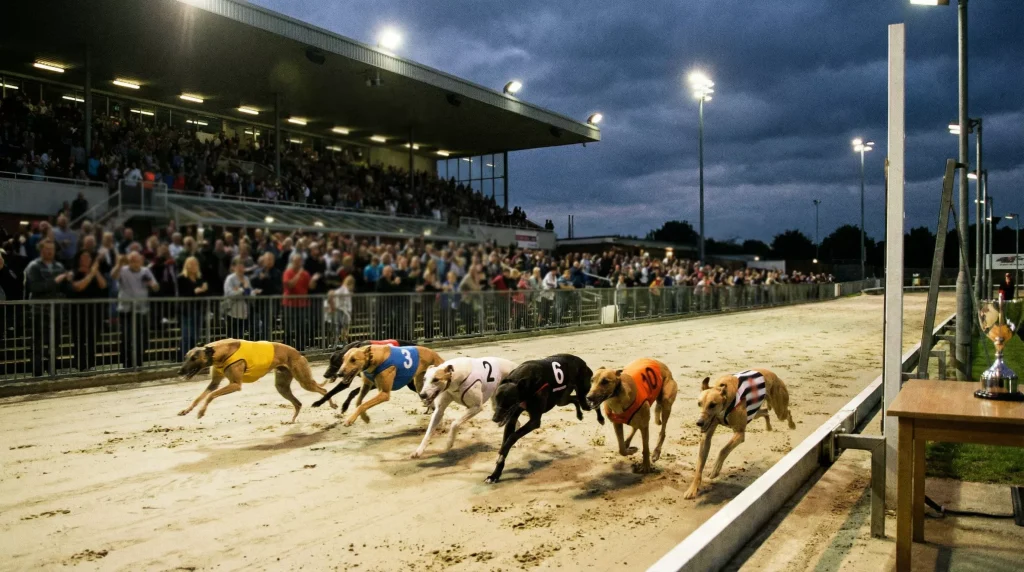
Open races are the top tier of UK greyhound competition. Unlike standard graded events, which restrict entry to dogs within a defined performance band, open races accept runners on the basis of ability alone — and the fields they produce represent the sharpest competitive edge the sport has to offer. The results from these races carry particular weight in the form book, because they measure dogs against the best available opposition rather than against a controlled subset of similarly graded rivals.
For punters, open-race results are the clearest indicator of true class. A dog that wins an open event has beaten a field selected for quality rather than administrative grade, and that achievement tells a different story from a win in a standard A3 or A4 race. Understanding how open races are structured, what the category-stakes system looks like and where to find their results is essential for anyone who analyses greyhound form beyond the everyday graded card.
What Qualifies as an Open Race
An open race is defined by the absence of a grade restriction on entry. While graded races accept only dogs classified within a specific band — A1, A2, A3 and so on — open races invite entries based on merit, with no upper or lower limit on the quality of the field. In practice, this means the strongest available dogs at a given track, or across multiple tracks, can be entered together in a single race.
Open races exist at several levels. At the lower end, a track may stage a local open that attracts the best dogs from its regular kennel pool — a step above the standard graded card but still a venue-specific event. At the higher end, national open competitions draw entries from kennels across the country, with trainers travelling their dogs to compete for significantly larger prize money and the prestige that comes with winning at the sport’s highest level.
The entry process for open races differs from graded racing. Trainers nominate dogs based on their form, and the racing manager or event organiser may apply qualifying criteria — a minimum number of recent runs, a form standard, or a time requirement over the relevant distance. This curation ensures that open-race fields are competitive, which is the entire point: the format exists to produce races where the outcome is decided by quality, not by administrative classification.
For results interpretation, the distinction between an open race and a graded race is fundamental context. A third-place finish in a national open may represent a higher level of performance than a win in a low-grade event. The results data typically displays the race type alongside the standard finishing information, making it possible to filter open-race results from graded results when conducting form analysis. Ignoring that filter means treating fundamentally different competitive contexts as equivalent — a mistake that distorts any assessment of a dog’s true ability.
Category Stakes: Structure and Prize Levels
Within the open-race tier, category stakes provide a formal hierarchy. The system runs from Category One at the top — reserved for the sport’s championship events — down through Categories Two, Three and Four. Each level carries different prize money, different entry standards and a different level of prestige within the racing community.
Category One races include the English Greyhound Derby, whose winner in 2025 collected £175,000 from a total annual prize fund across all licensed UK greyhound racing of approximately £15.7 million. That single payout represents more than 1% of the sport’s entire annual prize money — a concentration of financial value that reflects the Derby’s status as the competition every owner and trainer targets above all others. Other Category One events include the Arc and a small number of championship finals that occupy the very top of the sport’s competitive ladder.
Category Two and Three events sit below the championship tier but above standard local opens. They attract strong fields and carry meaningful prize money — enough to justify the effort and expense of travelling a dog to a venue outside its home track. These mid-tier category stakes are where much of the serious form analysis happens, because the fields are strong enough to test genuine ability but not so exclusive that only a handful of dogs are eligible. The results from Category Two and Three races provide the broadest base of high-quality form data for dogs that are competitive at the open level but not quite championship class.
Category Four events are the entry point to the category-stakes system — a step above a standard track open but below the nationally significant competitions. They serve as proving grounds for dogs that are being tested against better opposition before a decision is made about whether to target a higher-level campaign. Results from these races are useful for identifying improvers and potential class dogs before the market fully prices them in.
Where to Find Open Race Results
Open-race results are published through the same GBGB data infrastructure as all licensed greyhound results. Finishing positions, SPs, sectional times and race comments are available on bookmaker platforms and independent form databases after each race. The key difference is in how you identify them: the race type — open, category stake, invitation — is displayed alongside the standard result data, allowing you to filter specifically for open-race results rather than mixing them with graded form.
For major category-stakes events, results typically receive wider editorial coverage. Racing media, tipsters and form sites will often publish previews, in-race analysis and post-race comment for Category One and Two events, adding qualitative context to the raw data. This editorial layer can be useful for understanding the form implications of a result — particularly when a race produced an unexpected outcome that the data alone does not fully explain.
Archived open-race results are especially valuable for longitudinal analysis. Comparing the quality of Derby finalists across multiple years, or tracking how Category Two winners perform when they step up to Category One events, reveals patterns about the sport’s competitive trajectory that single-season data cannot capture. The results are all there in the standard databases — the only requirement is knowing how to filter for the right race types and reading them with the appropriate competitive context in mind.
One practical note: because open races attract the strongest fields, the results tend to produce shorter-priced winners and tighter finishing margins than graded events. A winner by half a length in a Category One semi-final may be demonstrating a higher level of ability than a winner by six lengths in an A6 race, and adjusting your assessment for the competitive standard of the field is the key discipline that separates useful open-race analysis from a superficial reading of finishing positions.