Greyhound Results Monmore — Wolverhampton Track Overview
Best Greyhound Betting Sites – Bet on Greyhounds in 2026
Loading...
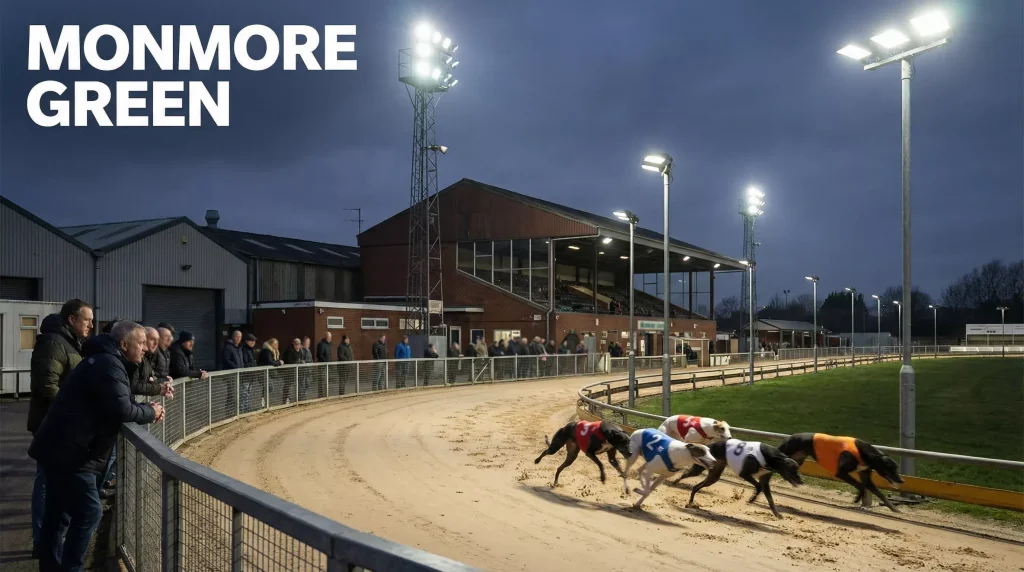
Monmore Green is the Midlands’ flagship greyhound venue — a GBGB-licensed stadium in Wolverhampton that has served as the region’s racing hub for decades. It is one of the 18 licensed tracks operating in England and Wales, and its central location makes it a natural crossroads for trainers and dogs from across the middle of the country. For punters, Monmore delivers a dependable stream of results through regular fixtures that cover both BAGS afternoon meetings and evening open cards.
Wolverhampton itself has deeper roots in greyhound and racing culture than casual observers might expect. In March 2026, the city’s Dunstall Park racecourse hosted the first combined horse and greyhound race day in UK history, a centenary celebration that underlined how deeply the sport is woven into the local fabric. While Monmore and Dunstall Park are separate venues, they share a city and a sporting identity — and Monmore’s consistent fixture programme keeps Wolverhampton firmly on the national greyhound map week after week.
Monmore Green Track Profile
Monmore Green operates over distances of 264, 480 and 630 metres, with the 480m trip forming the backbone of its race programme. The track is a medium-sized oval that sits between the tighter London circuits and the more expansive rural venues in terms of bend radius and overall feel. This produces racing that tends to reward dogs with a combination of early pace and the ability to hold a bend without losing ground — not quite as raw-speed dependent as a sprint track, not quite as stamina-heavy as a full galloping circuit.
The 264m sprint distance at Monmore is a straightforward speed test where trap draw and reaction time are the dominant factors. Results at this distance are harder to use for form analysis beyond identifying dogs with genuinely quick break speed. The 480m trip is where the meaningful form data lives: it is the distance most frequently raced, most consistently graded and most useful for comparing dogs across multiple runs. The 630m marathon trip appears less often on the card but is valuable for identifying stayers whose form profiles do not fit the standard middle-distance template.
Track geometry at Monmore gives a mild advantage to inside draws, though the effect is less pronounced than at tighter venues like Romford. A dog drawn in trap 1 or 2 saves ground on the bends, but the radius is generous enough that a dog drawn in trap 5 or 6 can compete on roughly equal terms if it possesses sufficient early pace to hold its position entering the first turn. Punters assessing Monmore results should factor in trap position but avoid over-weighting it — the track is more balanced than its London counterparts in this respect.
The sand surface is maintained to GBGB standards, with routine inspections ensuring consistency. Monmore’s inland Midlands location means going conditions tend to be more stable than at coastal tracks, though extended wet or dry spells will still produce measurable shifts in race times. Tracking the going description across meetings helps contextualise times that might otherwise look unusually fast or slow. Trainers with kennels in the Midlands often use Monmore as their primary track, which means the kennel form patterns at this venue can be particularly informative — a trainer in a hot streak at Monmore is usually reflecting genuine fitness in the yard rather than the random variance that smaller-sample tracks sometimes produce.
Accessing Monmore Results
Monmore results are distributed through the standard GBGB data pipeline. Finishing positions, starting prices, sectional times and race comments are available on all major bookmaker platforms and independent greyhound form sites within minutes of each race concluding. The track’s regular fixture frequency means there is seldom more than a day or two between Monmore meetings, which keeps the data flowing and makes recent form readily available for analysis.
For users who follow Monmore specifically, most form sites offer a track-level filter that isolates Monmore results by date. This is the cleanest way to build a track-specific picture: reviewing a full meeting card in sequence, noting the grade of each race, the trap draws, the SP movements and the sectional times. Over the course of a few weeks, this builds into a detailed understanding of how the track is playing, which trainers are in form and which dogs are improving or regressing.
As with other high-frequency venues, Monmore’s results should be interpreted with awareness of the meeting type. BAGS afternoon cards and open evening meetings attract different field compositions and, occasionally, different competitive intensity. Noting whether a result comes from a standard BAGS graded race or a higher-profile evening open is a basic but important step in contextualising the data correctly. A dog that finishes second in an open race may be showing better form than one that wins a low-grade BAGS contest, and the meeting type is the quickest way to distinguish between the two.
Monmore Meeting Pattern and Featured Races
Monmore runs a full weekly programme that typically includes three or more BAGS afternoon fixtures alongside scheduled evening open meetings. The track’s position as the principal Midlands venue means it bears a heavier fixture load than smaller regional stadiums, and this volume is reflected in the depth of form data it generates. A greyhound campaigned regularly at Monmore can build a substantial form record in a matter of weeks, giving analysts a solid base for assessment.
The track also hosts featured open races throughout the year, including regional championships and invitation events that draw entries from beyond the regular Monmore kennel pool. These fixtures carry higher prize money and attract stronger fields, providing a useful benchmark for assessing how regular Monmore runners measure up against broader competition. A dog that holds its form in an open event at Monmore is making a statement about its ability that a string of graded A3 wins cannot quite match.
Monmore’s featured events also contribute to the wider picture of UK greyhound racing’s competitive calendar. With 18 licensed tracks sharing approximately £15.7 million in annual prize money across the sport, the open-race programme is the mechanism through which individual venues stake their claim to a share of the sport’s upper tier. Monmore’s presence on that open-race circuit is consistent and well-established, which is why its results carry weight beyond the Midlands when serious form analysts compile their assessments.
For weekly planning, the fixture list is published by GBGB and replicated on all major form platforms. Monmore’s schedule is typically predictable enough to plan around, with regular afternoon and evening slots that repeat from week to week. Checking the upcoming card at the start of each week — noting distances, grades and any open-race fixtures — is the most efficient way to stay on top of what the Midlands racing hub is producing.