
Greyhound Results Betfair Starting Price — BSP Explained
 Available in US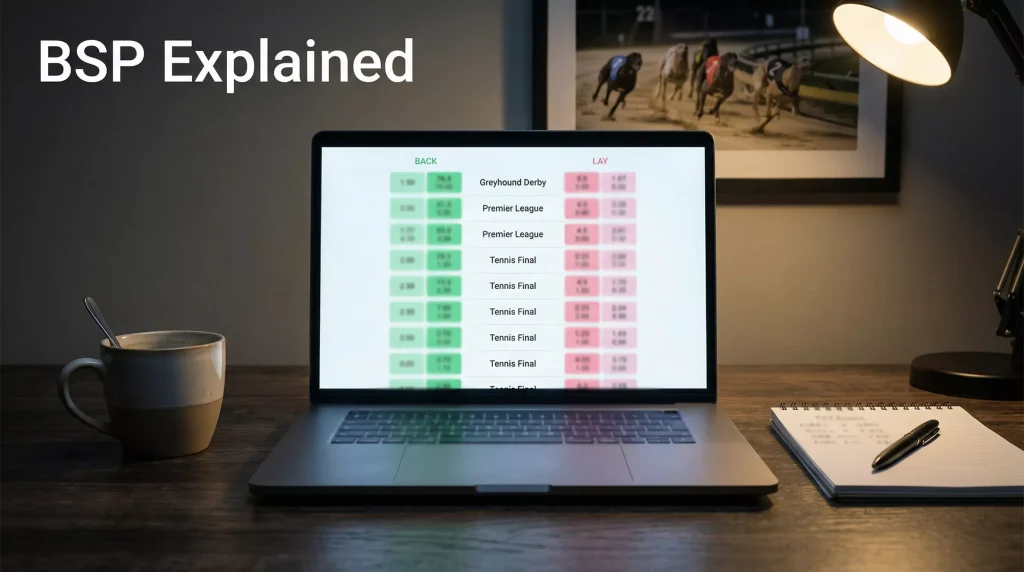
BSP — Betfair Starting Price — is the exchange price. It is the final set of odds generated by the Betfair exchange at the moment a greyhound race begins, calculated from the balance of back and lay bets placed by exchange users. For punters who bet through Betfair rather than traditional bookmakers, BSP is the default settlement price for unmatched bets and a key reference point for assessing market efficiency. For form analysts, it offers a second opinion on every runner’s chance — one that is generated by a different market mechanism from the conventional bookmaker SP. The wider context is set out in our UK greyhound results guide.
Understanding how BSP is calculated, when it diverges from traditional SP and where to find it in results data gives punters an informational edge that most casual bettors do not exploit. This guide covers each of those elements in practical terms.
How BSP Is Calculated
Betfair’s Starting Price is derived from the pool of unmatched back and lay bets sitting on the exchange at the moment the race starts. The calculation finds the price at which the maximum volume of bets can be matched — in economic terms, the market-clearing price. It is not set by a bookmaker, not influenced by on-course trading, and not subject to the overround that traditional bookmakers build into their odds. BSP is, in principle, the purest expression of market opinion available for any greyhound race.
The calculation happens automatically. In the seconds before a race begins, the exchange’s algorithm assesses all pending back bets (people wanting to bet on a dog to win) and lay bets (people willing to take the other side of that bet) and determines the price at which the greatest possible volume can be matched. Any bets that cannot be matched at BSP are voided. The result is a single price for each runner that reflects the collective view of the exchange’s users at the last possible moment.
The scale of the market behind greyhound BSP varies by meeting type. For high-profile evening meetings and Category stakes, the exchange liquidity can be substantial — enough to produce a BSP that is statistically robust and reflective of genuine market opinion. For quieter BAGS afternoon meetings, the exchange liquidity is thinner, and the BSP may be based on a smaller pool of bets. This matters because a thin market can produce a BSP that is more volatile and less reliable as a form indicator. UK greyhound betting as a whole generates approximately £794 million in off-course turnover, but only a fraction of that flows through the exchange — the majority is wagered with traditional bookmakers.
One technical detail worth noting: BSP includes a commission deduction. Betfair charges winning bettors a percentage of their net profit, which means the effective return from a BSP bet is slightly lower than the headline price. The commission rate varies by user — Betfair operates a tiered system based on volume — but the standard rate is typically around 5%. This means a BSP of 4.0 (3/1 in fractional terms) does not deliver exactly £3 profit per £1 staked; the actual return is reduced by the commission. When comparing BSP with bookmaker SP, the commission should be factored in to get an accurate like-for-like comparison.
BSP vs SP: When to Use Which
The choice between BSP and SP depends on what you are trying to achieve. For outright betting, BSP tends to offer better value on favourites — the exchange price is often marginally longer than the bookmaker SP for short-priced dogs, because exchange users are price-sensitive and resist paying over the odds for obvious contenders. On outsiders, the advantage is less consistent; bookmaker SP can sometimes be more generous than BSP, particularly when the exchange market is thin and a single large lay bet pushes the price shorter.
For form analysis, comparing BSP and SP on the same runner reveals where informed money was concentrated. If a dog’s BSP is significantly shorter than its SP, the exchange attracted heavy support — possibly from punters who identified value that the on-course bookmakers did not price in. If the BSP is longer than the SP, the exchange was less enthusiastic than the track market, which may indicate that on-course money (which can include insider information from kennel connections) drove the price down.
Greyhound racing represents 12.8% of average licensed betting office turnover — a figure that underscores the scale of the traditional bookmaker market relative to the exchange. The SP is set by that on-course, LBO-connected market; the BSP is set by exchange users, many of whom are purely online and may have different information sources. Neither price is inherently more accurate than the other, but using both in combination gives a fuller picture of how the market assessed each runner.
In practical terms, many experienced greyhound punters keep accounts with both a traditional bookmaker and Betfair, taking whichever price is better at the time of betting. For form analysis, recording both BSP and SP alongside each result allows you to track whether one market is systematically under- or over-pricing certain types of runner — a pattern that, if it persists, represents genuine analytical value.
Finding BSP Data in Results
BSP is displayed on Betfair’s own results pages, where it appears alongside finishing positions and other standard race data. For each race, the BSP column shows the Betfair Starting Price for every runner, making it straightforward to compare with the bookmaker SP displayed on other results platforms.
Independent form databases vary in whether they include BSP. Some of the more comprehensive services — particularly those aimed at serious form students — display both SP and BSP side by side, which is ideal for comparative analysis. Others show SP only, in which case you would need to cross-reference with Betfair’s results page to obtain the exchange price. The extra step is minor, but it is worth building into your workflow if you take price analysis seriously. The traditional price is explained in what SP means.
For systematic BSP tracking, the most efficient approach is to record the BSP for each runner in a personal spreadsheet or database alongside the SP, finishing position and other form data. Over time, this builds a dataset that reveals track-specific or trainer-specific patterns in how the exchange prices greyhound runners compared with the traditional market. These patterns — where they exist — are the exchange price’s most valuable contribution to form analysis, and they are only visible through disciplined, cumulative data collection rather than casual observation. The exchange price is not a magic number; it is a complementary data point that becomes powerful when systematically compared with the traditional market price across hundreds of results.
