BAGS Greyhound Results — How Bookmaker Racing Works
Best Greyhound Betting Sites – Bet on Greyhounds in 2026
Loading...
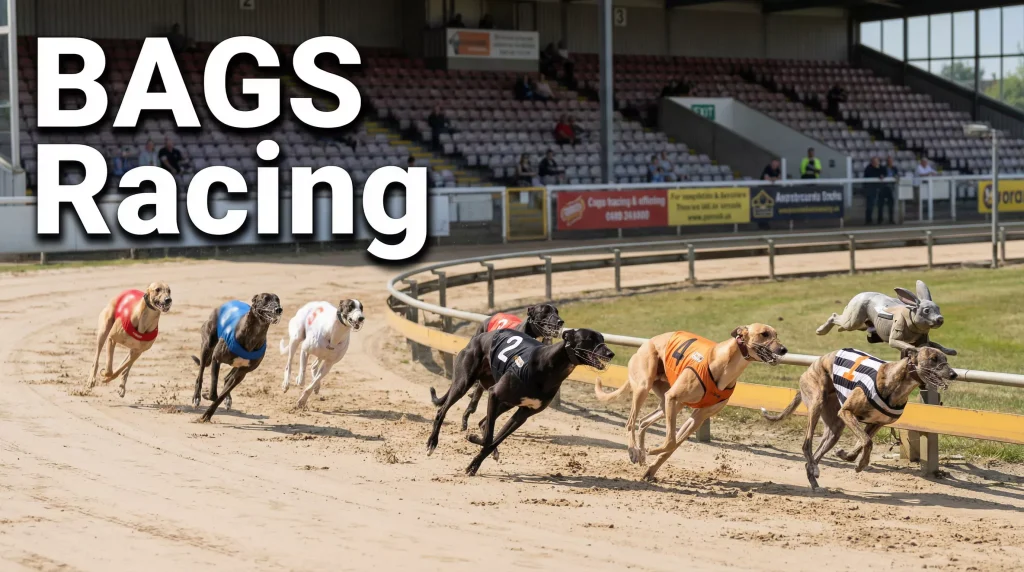
Most people who bet on greyhounds do so during the afternoon — a quick punt between lunch and the school run, or a few races tracked on a betting-shop screen while waiting for the evening football. What they may not realise is that the vast majority of those afternoon races exist because of a single commercial framework called BAGS. The Bookmakers Afternoon Greyhound Service is, in the most literal sense, the engine room of daily racing: it contracts tracks to stage meetings specifically for the betting market, generating a constant supply of live content for bookmakers and their customers.
BAGS races account for more than 25,000 individual contests per year across licensed UK tracks. That volume makes it the backbone of greyhound betting in Britain, yet the term itself remains surprisingly obscure outside industry circles. Understanding what BAGS is, how it shapes the racing calendar and where to find BAGS-specific results is fundamental for anyone who follows greyhound form with any regularity — because the races you are watching, and the results you are analysing, are overwhelmingly BAGS races.
What BAGS Stands for and How It Operates
BAGS stands for the Bookmakers Afternoon Greyhound Service. It was established in 1967 as a mechanism to provide licensed bookmakers with a reliable supply of live greyhound racing during afternoon hours — a time slot when horse racing coverage was sparse and betting shops needed content to keep customers engaged. The concept was straightforward: tracks would stage meetings timed for the afternoon, and bookmakers would receive the races via live broadcast, giving punters something to bet on between the morning markets and the evening card.
The operational model has not changed in principle since then, although its scale has expanded dramatically. BAGS contracts with licensed GBGB tracks to stage a set number of meetings per week. The tracks receive a fixture fee for hosting, which supplements their regular evening-meeting income. Bookmakers, in turn, get a continuous feed of live racing content to populate their shop screens and online platforms. It is a symbiotic arrangement: without BAGS, many tracks would struggle financially; without tracks staging afternoon races, bookmakers would lose a significant slice of their daily greyhound turnover.
The races themselves are standard GBGB-licensed affairs — same rules, same grading, same regulatory oversight as any evening open meeting. The only structural difference is scheduling. BAGS meetings typically begin in the late morning and run through the afternoon, with races spaced at roughly fifteen-minute intervals. The dogs are graded by the track in the same way as evening runners, using the standard A1-through-A10 system, and the results carry the same weight in the form book.
One nuance worth noting: because BAGS meetings are contracted by bookmakers, the fixture list is driven partly by commercial demand rather than purely by the track’s own calendar. A track that attracts strong betting volume on its afternoon cards is more likely to retain — or gain — additional BAGS fixtures. This creates an incentive for tracks to maintain competitive fields and consistent race quality, which in turn benefits form analysts who rely on the integrity of the data. It also means that BAGS scheduling decisions reflect the betting market’s appetite rather than the sporting calendar alone — a distinction that matters when you are trying to understand why certain tracks race far more frequently than others.
BAGS Volume: Meetings, Races, Tracks
The numbers behind BAGS are striking. The service generates more than 25,000 races per year — a figure that dwarfs the output of open-race meetings and evening fixtures combined. Since 2018, the number of weekly BAGS meetings across all participating tracks has climbed from 46 to 74, reflecting both increased bookmaker demand and the expansion of online betting platforms that require a constant stream of content.
That growth has structural consequences. With 74 meetings per week spread across the 18 GBGB-licensed stadiums, several tracks now host BAGS fixtures on most weekdays, sometimes doubling up with an afternoon BAGS card and an evening open meeting on the same day. Romford, Crayford, Monmore and Swindon are among the venues that feature most frequently on the BAGS schedule, though the rotation shifts depending on contractual cycles and track availability.
For form analysts, this volume is both an asset and a challenge. On the asset side, the sheer number of races means that data accumulates quickly — a dog running in BAGS meetings can build a form line of five or six races in a matter of weeks, giving punters a substantial sample to work with. On the challenge side, the density of the schedule means that dogs are racing more frequently, and fatigue or minor fitness issues can creep in without obvious warning signs in the form figures. Knowing which meetings are BAGS fixtures helps frame expectations: these are working cards, not showcase events, and the fields are graded accordingly.
The volume also affects the betting market. Because BAGS races run in the afternoon — when online betting activity peaks across several sports — they attract a different profile of bettor compared with a Saturday evening open meeting. Liquidity can be thinner on individual races, which makes starting prices more susceptible to late money. Understanding this market dynamic is part of reading BAGS results intelligently rather than treating them identically to evening fixtures.
Where to Find BAGS-Specific Results
BAGS results are published through the same infrastructure as all licensed greyhound results. GBGB data feeds supply finishing positions, starting prices, sectional times and race comments to bookmaker platforms and independent form sites in near real time. There is no separate BAGS results portal — the results sit alongside evening-meeting data within the standard greyhound results architecture.
That said, identifying which results came from BAGS meetings is straightforward once you know what to look for. The race time is the clearest indicator: any meeting starting before approximately 5pm on a weekday is almost certainly a BAGS fixture. Some results services tag meetings with their fixture type (BAGS or open), but this is not universal. The simplest approach is to filter by time of day and cross-reference with the published fixture list, which GBGB and most major form sites update weekly.
For punters who want to separate BAGS form from evening form in their analysis, this distinction matters. A dog that has been running exclusively in BAGS meetings may face a different competitive environment when stepping up to a Saturday open card — slightly stronger fields, a livelier atmosphere, and potentially different track conditions if the racing surface has been prepared for a premium fixture. Conversely, a dog moving from evening races into the BAGS schedule may find the transition smoother than expected, particularly if it handles the slightly earlier start time and different crowd energy without issue.
The key takeaway is practical: BAGS results are not second-tier data. They represent the majority of licensed racing output in Britain, and any serious form analysis that ignores them is working with an incomplete picture. Treat them as the core dataset — because, statistically, that is exactly what they are.