Greyhound Results Crayford — North Kent Track Data
 Available in US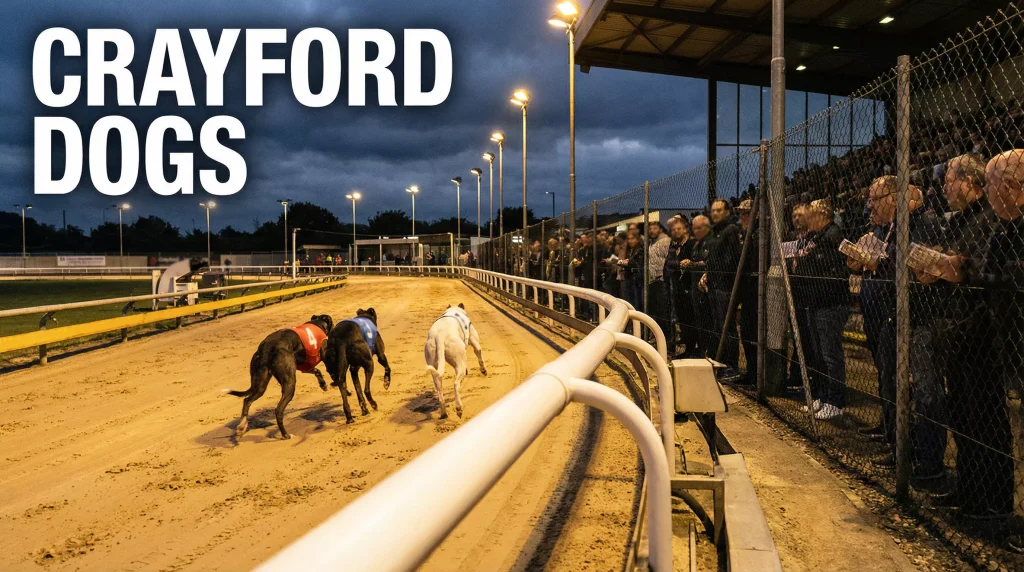
Crayford is Kent’s busiest oval — a GBGB-licensed greyhound stadium in North Kent that operates one of the highest-frequency fixture programmes of any track outside central London. Situated on the south-eastern fringe of the capital, it draws runners and punters from across Kent, south-east London and beyond, and its consistent output of results makes it a staple of the national greyhound form book. Crayford is one of 18 licensed stadiums in England and Wales, and it pulls its weight in that group with a volume of racing that few other venues match. The wider context is set out in our UK greyhound results guide.
The track’s appeal to punters is partly about convenience — it is accessible from London by road and rail — and partly about data density. Crayford races frequently, which means form accumulates rapidly for dogs based there. For anyone building a systematic approach to greyhound analysis, Crayford produces the raw material at a rate that supports robust, evidence-based assessment rather than speculation built on thin data.
Crayford Track Profile
Crayford operates over distances of 380, 540 and 714 metres, with the 380m trip serving as the track’s core race distance. This is slightly shorter than the 400m or 480m standard found at many other venues, and it gives Crayford a distinctive tactical profile: races here tend to be sharper, more speed-dependent and more heavily influenced by the first bend than at tracks with longer standard distances.
The 380m distance means that a dog’s break from the traps and its position entering the first turn are often decisive. There is less time and less space for a slow starter to recover compared with a 480m or 500m race. This makes trap draw a significant variable at Crayford — inside draws benefit from saving ground on tight bends, and the data consistently reflects a higher win rate for traps 1 and 2 at this track than the theoretical equal split would suggest. The BAGS programme alone generates more than 25,000 races per year across all licensed venues, and Crayford claims a substantial share of that afternoon action, producing a deep pool of results from which these trap-draw patterns emerge clearly over time.
The 540m distance introduces an extra bend and an additional straight, which shifts the balance slightly towards dogs with more sustained pace. Form analysis at 540m is different from 380m form — a quick breaker that dominates at the shorter trip may find itself under pressure from a stronger finisher at the longer distance. Treating these as separate form contexts, rather than blending them into a single Crayford assessment, produces better results.
The 714m marathon distance is the longest standard trip on Crayford’s card and attracts a specialist pool of stayers. Results at this distance are useful for identifying dogs with genuine stamina, but the sample size is smaller and the fields sometimes less competitive than at the standard distance. The sand surface is maintained to GBGB standards, and going conditions vary with the weather — though Crayford’s south-eastern location generally delivers milder, drier conditions than northern venues, producing a faster surface for much of the year.
One analytical detail that distinguishes Crayford from many of its peers is the 380m standard distance itself. Because it is shorter than the 400m or 480m norm at most other tracks, form generated at Crayford does not translate directly to longer-distance venues without adjustment. A dog that dominates at 380m may lack the stamina for a competitive 480m race at Monmore, while a strong finisher at a bigger track may never get into the race at Crayford because the shorter trip does not give it enough time to close. Keeping this distance differential in mind when cross-referencing Crayford form with results from other venues is a basic but easily overlooked discipline.
Crayford Results Access and Format
Crayford results are published through the same GBGB data pipeline as every other licensed track. Finishing positions, starting prices, sectional times and race comments appear on all major bookmaker platforms and independent form databases within minutes of each race concluding. For a track with Crayford’s fixture volume, that means new data is available almost daily — a significant advantage for punters who prefer working with recent, track-specific form.
The results format is standard: trap draw, finishing position, starting price, winning time, official distances and race comments for each runner. Most form sites also display the grade of each race, which is essential context for interpreting the level of competition. An A2 race at Crayford represents a different competitive band from an A7, and ignoring the grade when reading results is a common mistake that leads to inflated or deflated assessments of a dog’s ability.
For users who follow Crayford regularly, filtering by track and date on a preferred form site is the most efficient workflow. This isolates the full meeting card in race-by-race order and allows a sequential read-through that reveals patterns — which traps performed well on the day, whether the going favoured pace or stamina, which trainers had multiple runners in form. This meeting-level view is more informative than pulling individual race results out of sequence.
Crayford Meeting Schedule
Crayford races multiple times per week, hosting BAGS afternoon meetings on several weekdays and open evening cards at least twice a week. This frequency places it among the busiest venues in the country and ensures a near-constant flow of form data for dogs based at the track. A greyhound running regularly at Crayford might accumulate four or five results in a fortnight, providing a robust recent form line for assessment.
The BAGS component of Crayford’s schedule is particularly substantial. The track is a natural fit for the afternoon racing programme: its proximity to London supports strong betting-shop viewership, and its competitive fields maintain the quality that bookmakers require from their contracted fixtures. This commercial logic means Crayford is unlikely to lose BAGS slots in the foreseeable future, giving punters confidence that the track will continue to produce a high volume of results data.
Evening open meetings at Crayford draw slightly stronger fields and carry higher prize money, offering a competitive step up from the standard BAGS card. These meetings are useful comparison points: a dog that performs well in a Friday evening open after running consistently in weekday BAGS races is demonstrating progression, while one that falters at the step up may have reached its competitive ceiling. Reading the fixture type alongside the result adds a layer of interpretation that raw finishing positions cannot provide on their own. It also helps explain SP movements — a dog that was a short-priced favourite in BAGS company may drift in the market for an open race, reflecting the bookmakers’ assessment of the stronger opposition. Every other venue is listed in results by track.
The fixture list is published weekly by GBGB and available on all major form platforms. For a track with Crayford’s volume, it is worth checking the schedule at the start of each week to plan analysis time around the meetings that offer the best opportunities — whether that means targeting specific race grades, following particular trainers or simply monitoring how the track is playing across consecutive meetings.
