Greyhound Results Romford — Race Data From London's Busiest Track
 Available in US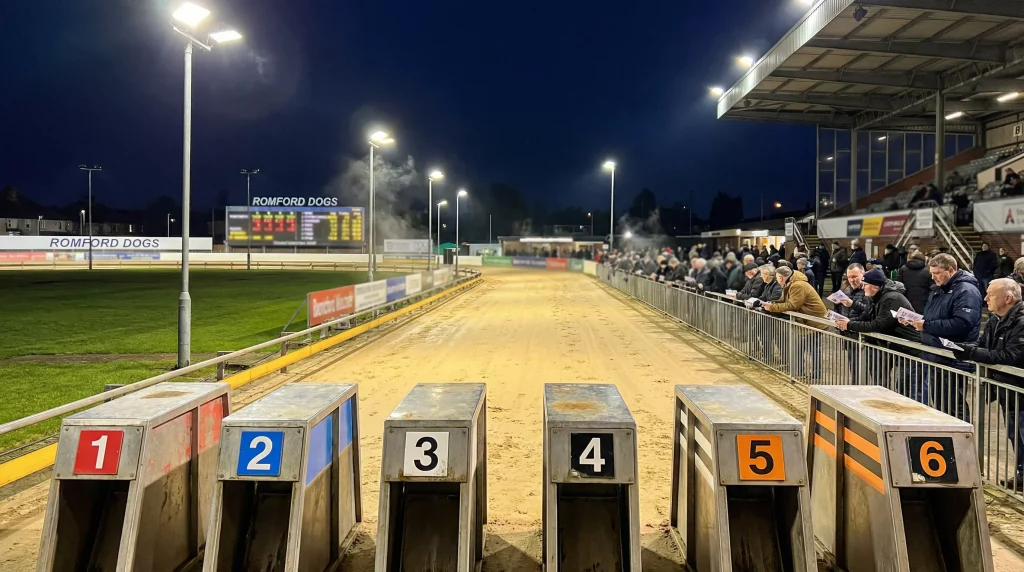
Romford is, by most practical measures, the busiest greyhound stadium in London. It races frequently, draws consistently competitive fields and generates more results data per week than almost any other venue in the capital. Situated in East London and operated under a full GBGB licence, it sits at the centre of the south-east’s greyhound racing infrastructure — one of 18 licensed stadiums currently operating in England and Wales. The wider context is set out in our UK greyhound results guide.
For punters, Romford’s importance is partly geographical and partly structural. It is easily accessible from central London, which supports healthy attendance figures and a liquid betting market. But it also stages a high volume of fixtures, including regular BAGS afternoon meetings and evening open cards, which means form data from the track accumulates rapidly. If you follow greyhound results in any depth, Romford will appear in your form book more often than most venues — and understanding how the track plays, what its quirks are and where to find its results efficiently is London’s greyhound heartbeat in data terms.
Romford Track Profile: Distances and Layout
Romford is a tight, fast circuit with a circumference that puts it at the compact end of the UK track spectrum. The standard race distances are 225, 400 and 575 metres, with 400m being the track’s bread-and-butter trip. The shorter 225m sprint is a dash from trap to line with almost no time to recover from a slow break, while the 575m distance introduces an extra bend and rewards dogs with sustained pace rather than pure early speed.
The track’s geometry favours inside runners more than some of its larger counterparts. The bends are relatively tight, which means a greyhound drawn in traps 1 or 2 has a genuine structural advantage — less ground to cover, less risk of being squeezed wide by the pack at the first turn. This does not mean outside draws are hopeless, but it does mean that trap position at Romford is a more significant variable than at a wider, more galloping track like Towcester or Nottingham.
The surface is standard sand, maintained to GBGB specifications and subject to regular inspection. Romford’s going can vary depending on weather conditions and the meeting schedule — a track that has already hosted an afternoon BAGS card may run slightly differently for the evening meeting, depending on how it has been prepared between sessions. This is worth noting when comparing sectional times across meetings on the same day. Trainers familiar with the venue will sometimes adjust their expectations for an evening runner based on how the afternoon card played out, and results data from both sessions should be read with that context in mind.
From a form perspective, Romford produces a particular type of result. The tight turns and short run-in from the final bend to the finishing line mean that races are often decided early. A dog that leads into the first bend at Romford will win more often than the national average, simply because there is less room and less time for rivals to make up ground. This track bias does not show up in every race, but across a large sample of results, it is a measurable pattern that serious form students factor into their assessments. It also means that early-pace figures — the sectional time to the first bend — are arguably more important at Romford than at any other London venue.
How to Access Romford’s Daily Results
Romford results are available through all the standard greyhound results channels. GBGB data feeds push finishing positions, SPs, sectional times and official race comments to bookmaker platforms and independent form databases within minutes of each race finishing. Most major betting sites — including those with dedicated greyhound sections — carry Romford results as a default, given the track’s high fixture volume.
For rapid access, bookmaker results pages are typically the fastest route. They update automatically after each race and display core data in a consistent, scannable format: finishing order, trap draw, starting price, winning time and distances between finishers. Independent form sites tend to add more detail — sectional splits, race comments, going description — and are better suited for deeper analysis, though they may lag a few minutes behind the bookmaker feeds.
One practical consideration: because Romford frequently hosts both afternoon and evening meetings, you may need to specify which session you are looking for when searching results. Most platforms separate these by meeting time, but if you are pulling data from an aggregated results page, checking the race time stamp avoids accidentally conflating BAGS afternoon form with evening open-race form. The competitive environments are not identical, and mixing them without awareness can distort a form picture.
Romford Meeting Schedule and Race Frequency
Romford races multiple times per week, typically hosting BAGS afternoon meetings on several weekdays and open evening meetings at least twice a week, including a regular Saturday evening card. The exact schedule shifts from week to week based on the BAGS contract cycle and fixture negotiations, but the overall pattern is consistent: Romford is one of the highest-frequency venues on the UK greyhound calendar.
That frequency matters for form analysis. A greyhound running regularly at Romford might accumulate four or five results within a fortnight, providing a robust recent form line. This density of data is a significant advantage compared with a dog that has been racing at venues with fewer fixtures, where the gaps between runs can stretch to two or three weeks. More data points mean more reliable trend identification — whether a dog is improving, declining or holding a steady level of performance.
The BAGS component of Romford’s schedule is substantial. With the national BAGS programme now running 74 meetings per week across all licensed tracks, Romford claims a disproportionate share of those afternoon slots. The commercial logic is clear: a London track with strong betting-shop viewership and reliable field sizes is exactly what the BAGS model is designed for. The result is a near-constant flow of racing — and results — from Romford that feeds directly into the national form book. Its afternoon cards come from BAGS racing.
For punters planning their week, the simplest approach is to check the published fixture list via GBGB or any major form site at the start of each week. Romford’s meetings will be listed with start times, race count and fixture type, making it straightforward to identify which days offer the most opportunities for tracking form or placing bets at the track. In a sport where over 25,000 BAGS races take place annually, Romford accounts for a notable share — and keeping on top of its schedule is a basic but essential habit for anyone following London greyhound form closely.
