Greyhound Derby Results — History, Winners and Prize Money
 Available in US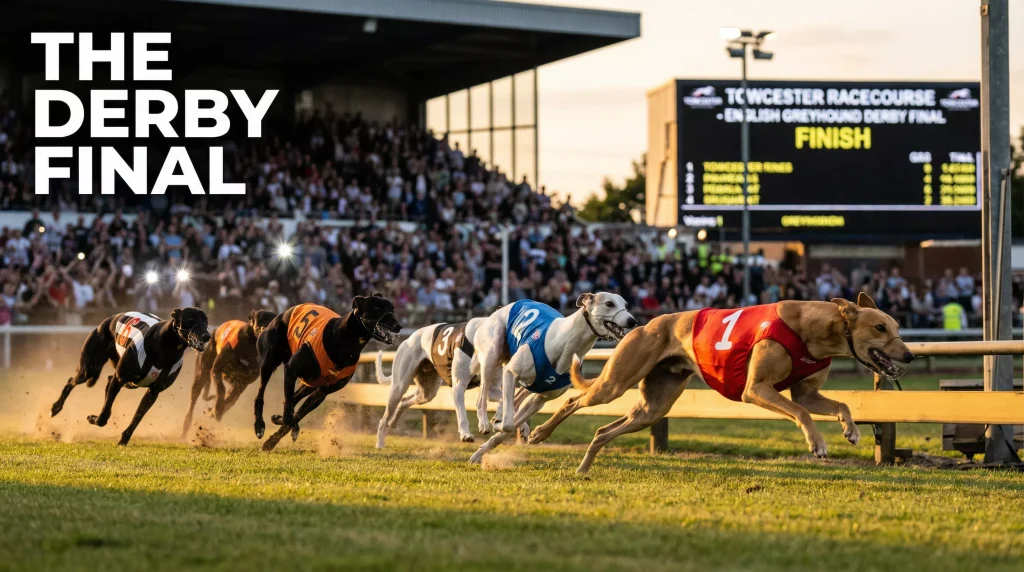
If greyhound racing has a single event that can silence a packed grandstand and hold an entire betting ring mid-breath, it is the English Greyhound Derby. Staged every summer, the Derby is the sport’s showpiece — a knockout competition that distils hundreds of entries into one final over 500 metres, with the last dog standing collecting a winner’s cheque that dwarfs any other prize in the calendar. For punters, it is the week where form books get tested against genuine class. For trainers and owners, it is the race that defines careers. The wider context is set out in our UK greyhound results guide.
The Derby’s significance goes beyond sentimentality. It is the most closely scrutinised greyhound race in Britain, and its results ripple outward: grading decisions, stud valuations and sponsorship deals all reference Derby pedigree. In a centenary year for UK greyhound racing, that heritage carries extra weight. The competition remains the clearest lens through which to view the sport’s quality — and understanding how it works, what the prize money looks like and where to access round-by-round results is essential for anyone following licensed racing seriously.
The Derby Format: Six Rounds Over 500 Metres
The English Greyhound Derby is a knockout event run over 500 metres at Towcester, structured across six rounds from first heats to the final. Around 180 greyhounds are entered at the start of each year’s competition. That pool is progressively reduced through heats, quarter-finals, semi-finals and ultimately the six-runner final, with every round held at the same distance on the same track — a deliberate design that rewards consistency over versatility.
Each round matters on its own terms. The early heats operate as a sieve, sorting genuine Derby contenders from dogs that simply lack the tactical speed for a 500-metre knockout on a galloping track like Towcester. Trainers manage their charge’s energy and trap position through the rounds, knowing that a single poor performance — a slow start, a bump on the first bend — can end the campaign instantly. There is no safety net, no wildcard route back in.
By the semi-final stage, the field is down to eighteen dogs contesting three races. The two qualifiers from each semi — plus a fastest loser, in some years — fill the six traps for the final. This is where the format’s tension peaks: every semi is essentially a final in miniature, because a dog can be the third-fastest greyhound in the competition and still miss out if it draws a tough heat.
The 500-metre distance is itself a selection mechanism. It is the standard middle-distance trip in British greyhound racing, long enough to expose dogs that cannot sustain early pace and short enough to punish those that rely purely on stamina. Towcester’s wide, galloping layout — with sweeping bends and a long run to the first turn — amplifies this. Rail runners with quick break speed have a structural advantage, but dogs drawn wide can compensate if they possess enough mid-race pace to work into contention before the final bend.
From a results perspective, the round-by-round format generates a rich data trail. Each heat produces sectional times, finishing positions, starting prices and comments that feed directly into the form book for the next round. By the time the finalists line up, there is a detailed picture of how each dog has performed under competitive pressure on the same track, over the same distance, often against overlapping opposition. That depth of comparable data is unusual in greyhound racing, where most competitions are one-off graded events, and it gives serious form analysts a genuine edge.
Prize Money and Sponsorship
The 2025 English Greyhound Derby carried a winner’s prize of £175,000 — the largest single payout in UK greyhound racing and a figure that places it in a different financial universe from a standard graded race, where prize money might sit in the low hundreds. That headline number is backed by a full prize structure rewarding runners-up and semi-finalists, making the Derby the most lucrative single event across the sport’s calendar.
Sponsorship plays a central role in sustaining those figures. Star Sports has been the title sponsor in recent years, and the partnership reflects a broader commercial logic: the Derby attracts the highest concentration of betting interest of any greyhound event, so bookmaker sponsorship aligns neatly with audience reach. Ben Keith, owner of Star Sports, has described the relationship in direct terms: We are delighted to be working closely with the good people at Towcester Racecourse. They share our passion for this great sport and Star Sports and myself are delighted to once again be involved.
(GBGB)
It is worth putting the Derby’s prize fund in context. The total annual prize money across all licensed UK greyhound racing stands at roughly £15.7 million. The Derby winner alone takes home more than 1% of that entire pot in a single race. For trainers operating on tight margins — and the economics of greyhound training are rarely generous — a Derby finalist represents a career-altering result, not merely a good week.
The prize money also shapes the competitive landscape well before the final. Trainers will prepare dogs specifically for the Derby distance and conditions, sometimes adjusting a greyhound’s graded racing schedule in the months prior to ensure peak fitness for the June heats. That investment of time and resources is only rational because the financial reward justifies it. In a sport where most prize money is modest, the Derby’s purse acts as a gravitational centre, pulling the best dogs and the sharpest training operations into its orbit.
Accessing Derby Results and Round-by-Round Data
Derby results are published through the same channels as standard licensed race results — GBGB’s own data feeds, bookmaker result services and independent form sites — but the volume and granularity of data available for the Derby far exceeds a typical meeting. Each round generates a full results card for every heat: finishing positions, sectional times, starting prices, trap draw, race comments and official distances between finishers. Over six rounds, that accumulates into a substantial dataset for each surviving dog.
The most useful way to approach Derby results is chronologically, round by round. Start with the first heats and track a dog’s trajectory: did its sectional times improve as the competition intensified, or did it peak early? Was it consistently fast from trap, or did it rely on running on from behind? How did it perform when drawn on the inside versus the outside? These questions are answerable only when you follow the full sequence of results rather than looking at the final in isolation.
For punters, the semi-final results are particularly instructive. By that stage, every dog has already navigated three or four competitive rounds, and the semi-final times and margins often reveal more about true ability than the final itself — where the pressure of the occasion can produce messy, attritional races rather than clean, form-reliable ones. A dog that wins its semi with a fast time and daylight to the second is making a stronger statement than one that scrapes through by a neck after a troubled run. The Derby is run at Towcester.
Archived Derby results also serve a longer-term analytical purpose. Comparing the winning time, the favourite’s finishing position and the average SP of semi-final winners across multiple years can highlight whether the competition’s quality is rising, falling or holding steady. In a centenary year for UK greyhound racing, that kind of longitudinal view carries genuine interest — not just for bettors, but for anyone tracking the health of the sport’s showpiece event.
