How to Read Greyhound Race Results — Beginner's Breakdown
 Available in US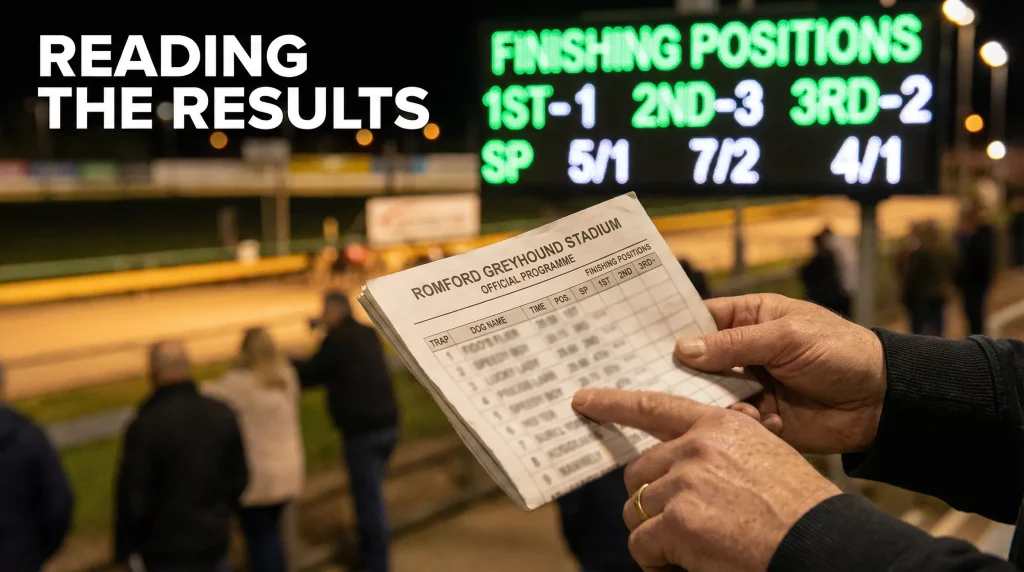
A greyhound results line is dense with information — and if you have never read one before, it can look like a wall of numbers and abbreviations that resists easy interpretation. Trap numbers, finishing positions, starting prices, sectional times, official distances and race comments are all compressed into a single row of data. Once you know what each element means, however, that same row becomes a compact summary of everything important that happened in a race. The full picture is in our UK greyhound results guide.
Decoding the data is a skill, not a gift. It takes a few minutes of structured learning, after which any greyhound results page becomes readable at a glance. This guide breaks down the key components of a standard UK greyhound results line, explains what the trap numbers and colours signify, and walks through the timing and positional data that form the backbone of serious race analysis.
Anatomy of a Results Line
A standard UK greyhound results line — as published on GBGB data feeds, bookmaker sites and independent form databases — typically contains the following elements in some variation of this order: trap number, dog name, finishing position, official distance behind the winner, sectional time, winning or finishing time, starting price (SP), and race comments. Some platforms add the trainer name, the dog’s previous form figures and the race grade alongside the result.
The trap number tells you where the dog started. UK greyhound races use six traps, numbered 1 to 6, with each assigned a specific colour. The finishing position is self-explanatory — 1st through 6th, with any dog that fails to finish recorded as DNF (did not finish) or with a specific annotation explaining the reason. The official distance measures the gap between consecutive finishers in lengths, giving you a quantitative read on how close or decisive the result was.
The starting price (SP) is the final set of odds at which bets on that dog were settled. It reflects the market’s assessment of the dog’s chance at the moment the traps opened. A dog that wins at a short SP was expected to win; one that lands at a long price has beaten the market’s expectation. Reading SP alongside finishing position tells you not just what happened, but how surprising the outcome was — and that matters for form assessment, because a dog that keeps winning at long odds may be improving faster than the market has recognised.
Race comments are the qualitative layer. Written by the race commentator or form compiler, they describe in shorthand how the race unfolded for each runner: led from trap, slow away, crowded at first bend, ran on well in the straight. These annotations add context that the raw numbers cannot capture. A dog that finishes third but was hampered by interference at the second bend has a different form story from one that finished third after a clean run in a clear lane. Learning to read race comments alongside the numerical data is what separates useful analysis from superficial result-checking.
One element that occasionally appears in results is a DNF annotation linked to injury. The on-track injury rate in licensed UK greyhound racing stands at 1.07% of all race starts — the lowest figure recorded by the GBGB — which means the overwhelming majority of results lines show a completed race. When a DNF does appear, the race comments will usually note whether the dog was withdrawn mid-race due to a veterinary issue, and that information should be factored into any subsequent form assessment.
Trap Numbers, Colours and What They Signal
Every UK greyhound race uses a standardised colour system for its six traps. Trap 1 is red, trap 2 is blue, trap 3 is white, trap 4 is black, trap 5 is orange and trap 6 is black-and-white stripes. These colours are printed on the racing jackets worn by each dog, making it possible to identify runners visually during a race — and, more importantly for results purposes, they appear in results data as a shorthand identifier.
The trap number is not merely a cosmetic label. It determines a dog’s starting position on the track, and that position has a measurable effect on race outcomes. Trap 1 consistently shows a win rate of approximately 18–19%, compared with the theoretical equal-chance figure of 16.6% that would apply if all six traps won at the same rate. That statistical bias exists because the inside draw saves ground on the bends — particularly at tighter tracks where the geometry amplifies the advantage of a shorter racing line.
This does not mean that trap 1 always wins, or that outside traps are doomed. The trap draw advantage varies significantly by track. At a tight circuit like Romford, the inside bias is more pronounced; at a wide, galloping track like Towcester, the difference between traps narrows considerably. Knowing which track a result came from — and understanding how that track’s geometry interacts with trap position — is a fundamental part of reading results accurately rather than treating all trap draws as equivalent.
For beginners, the practical takeaway is straightforward: always check the trap number alongside the finishing position. A dog that wins from trap 1 at a tight track has benefited from a structural advantage. A dog that wins from trap 6 at the same track has overcome one. Both results count as wins in the form book, but they tell different stories about the dog’s ability — and recognising that distinction early in your learning curve gives your analysis a sharper foundation. Professor Madeleine Campbell, the European veterinary specialist who authored GBGB’s welfare strategy, has described the framework as built to the highest standards: I spoke to academics, specialists, vets, global experts in animal welfare and a wide range of stakeholders to ensure that what we have put in place is world class in its approach.
(VetClick) That framework extends to the data standards governing results publication, which is why the trap numbers, positions and times you see in the form book are reliable enough to support the kind of analysis that separates casual observation from informed assessment.
Time, Position and Sectional Data
Timing data is the quantitative spine of any greyhound result. The winning time tells you how fast the race was run — measured in seconds and hundredths of a second from the moment the traps open to the moment the first dog crosses the finishing line. But the winning time alone is not enough for serious analysis. Sectional times — the split times recorded at intermediate points around the track — reveal how the race was run rather than just how fast it was won.
A typical UK greyhound result will include at least one sectional time, usually to the first bend or to the halfway point, alongside the overall race time. Comparing the sectional with the overall tells you whether a dog was fast early and faded, or slow early and closed strongly. A dog that records a quick sectional but a relatively slow overall time was burning energy at the front and tiring — a pattern that may recur in future races, especially if the dog is drawn in a trap that encourages early speed. Conversely, a dog with a slow sectional but a strong overall time was finishing powerfully, which suggests it might be better suited to a longer distance or a race where the early pace is strong enough to set up a closing run.
Position data adds another layer. Most results show each dog’s position at intermediate stages — first bend, second bend, home straight — as well as the final finishing order. Tracking a dog’s positional journey through a race tells you whether it raced prominently throughout or came from behind. A dog recorded as 6th at the first bend but 2nd at the finish has made up significant ground, while one that led at every call and still won has controlled the race from start to finish. These are fundamentally different performance types, and they project differently into future races depending on track conditions, trap draw and the opposition’s running styles. The price at the end of the line is the starting price.
The official distance — expressed in lengths — between each finisher quantifies how close the race was. A winner by six lengths has dominated; a winner by a short head has barely scraped home. For forecasting future performance, the margin matters: a dog that wins by a wide margin in an A4 race is more likely to handle a step up to A3 than one that won the same grade by a neck. Similarly, a dog that finishes a close second to a strong winner may be performing at a higher level than one that finishes a distant first against weak opposition. Reading distances alongside finishing positions and race grades gives the fullest picture of what each result actually means.
